How to Choose a Bearing
The choice of a bearing depends on several key factors: load type, speed, environment, and operating conditions. This guide will help you understand the selection criteria to optimize the performance and lifespan of your bearings.
Bearing Types and Applications
- Ball bearings: Designed for high speeds and moderate loads, they are perfect for small housings and precision applications. They are often used in machine tools, fishing reel equipment, industrial fans, and more.
- Roller bearings: Known for their high load-carrying capacity, they are ideal for applications such as conveyors or industrial machine spindles. They are available in tapered, cylindrical, and spherical variants, each with tailored properties.
- Needle roller bearings: Used in tight spaces, such as power tools and transmissions, these bearings offer a high radial load capacity with a compact footprint.
Load Types: Static and Dynamic
Selecting a bearing depends largely on the type of load it must support. There are two main types of loads:
- Dynamic load: This load is applied to the bearing in motion and represents the maximum load it can withstand over a long period. This is referred to as the basic dynamic load rating, which is used to estimate the bearing's lifespan based on the load and rotational speed. The closer the load is to the maximum dynamic load, the faster the bearing will wear out.
- Static load: Static load refers to the load applied when the bearing is stationary. It is essential in applications where bearings are subjected to high pressure without movement, for instance, during rest periods under a heavy load. The static load involves stress on the contact points between the rolling elements and the raceway, influencing the bearing's resistance to extreme pressures and localized impacts.
Key Factors for Selection
- Load type and magnitude: The applied load is crucial when selecting a bearing. Heavy radial loads typically require roller bearings, while axial (thrust) loads may be better supported by thrust bearings or angular contact ball bearings.
- Operating speed and temperature: Speed influences lubrication requirements and the type of bearing needed. Ball bearings, for example, are well-suited for high speeds, whereas spherical roller bearings are adapted for heavy loads at lower speeds.
- Lifespan and lubrication: Lubrication plays a key role in the longevity of bearings. Using appropriate greases or specialized lubricants is necessary to minimize wear and control operating temperatures. Specific sealing solutions can also significantly increase a bearing's lifespan.
Practical Selection Tips
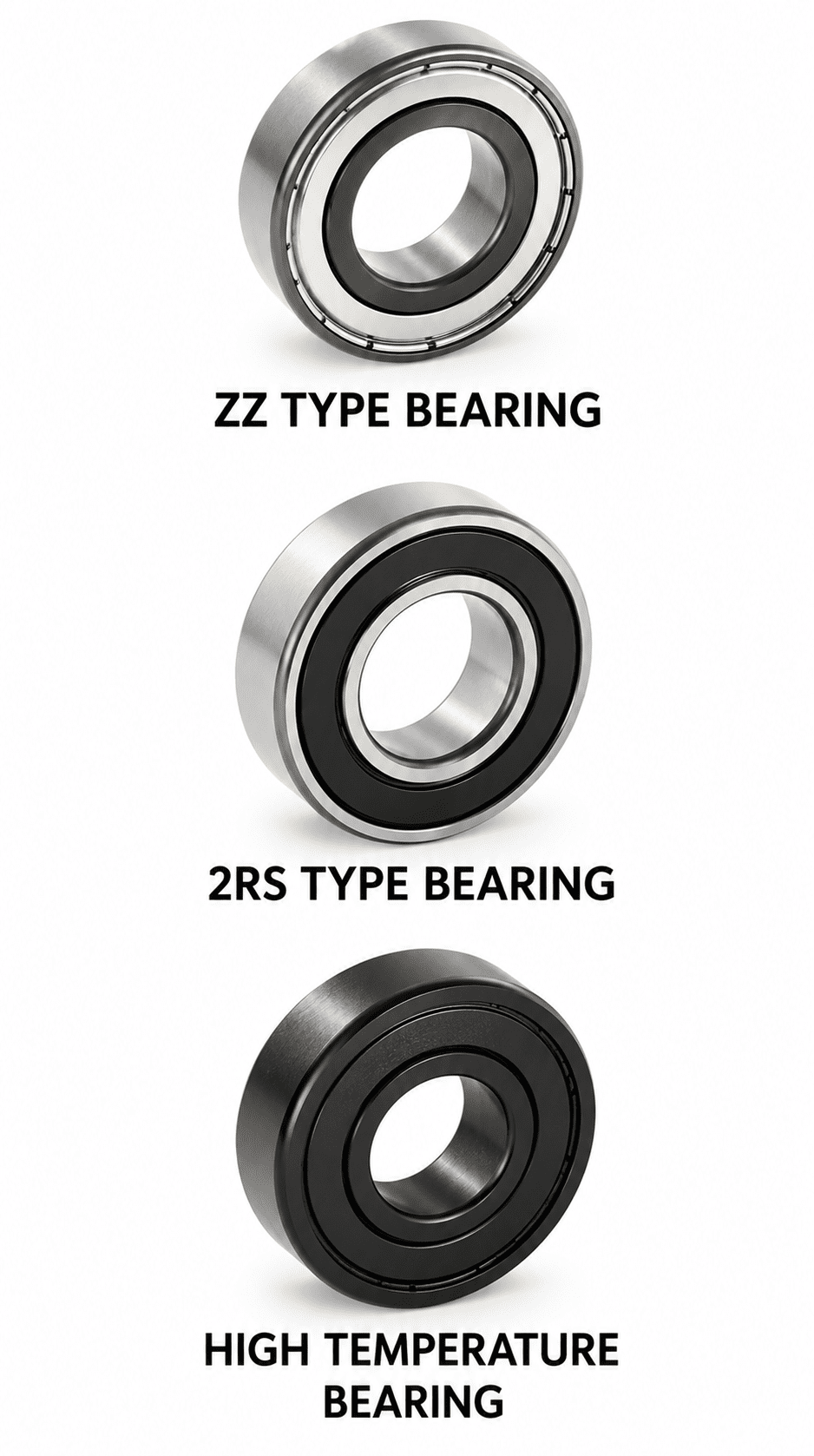
- Analyze environmental conditions: Dust, moisture, or extreme temperatures require specific materials and seals. For dusty environments, a shielded bearing (type "ZZ") is preferred; for wet or damp environments, sealed bearings (type "2RS") are ideal; and for environments exposed to extreme heat, we recommend our range of high-temperature ball bearings.
- Consider tolerances and rigidity: For high-precision applications, tight manufacturing tolerances are required. Rigidity, particularly for machine tool applications, ensures overall system stability.
- Plan for mounting and maintenance: The ease of mounting and dismounting the bearings must also be considered, especially for applications requiring regular inspections. Certain bearings, like cylindrical roller bearings, allow for simplified maintenance, which improves machine longevity and limits downtime.
Conclusion
Choosing the right bearing requires taking into account several technical and environmental parameters to guarantee optimal performance and increased longevity. By selecting the bearing type tailored to the specific loads, rotational speeds, and operating conditions, you will optimize the performance of your machinery and equipment. Accurately evaluating your needs and maintenance requirements also helps extend the life of the bearings while reducing the risk of premature wear. Ultimately, a careful selection ensures better productivity and simplified maintenance, which is essential for any industrial or domestic application.
 DEEP GROOVE BALL BEARING
 NEEDLE ROLLER BEARING
 ROLLER BEARING
 HOUSED BEARING
 ROD END
 OTHER BEARINGS
 GEARBOX BEARING
 AGRICULTURAL BEARINGS
 WHEEL BEARING
 SINGLE ROW
 DOUBLE ROW
 CERAMIC BEARING
 THRUST BALL BEARING
 SELF ALIGNING BALL BEARING
 CASTOR BEARING
 HIGH TEMPERATURE
 CAM FOLLOWER
 TRACK ROLLER
 MAST GUIDE BEARING
 BALL BEARING RETAINER
 DRAWN CUP ROLLER BEARING
 NEEDLE ROLLER BEARING
 AXIAL NEEDLE ROLLER
 INNER RING
 NEEDLE ROLLER CAGE
 DRAWN CUP ROLLER CLUTCHES
 TAPERED ROLLER BEARING
 ROLLER BEARING
 YOKE TYPE TRACK ROLLER
 SPHERICAL ROLLER BEARING
 THRUST ROLLER BEARING
 ROLLER BEARING CAGE
 RAW CONE
 RAW CUP
 HOUSED BEARING 0 BOLT
 HOUSED BEARING 1 BOLT
 HOUSED BEARING 2 BOLTS
 HOUSED BEARING 3 BOLTS
 HOUSED BEARING 4 BOLTS
 HOUSED BEARING ACCESSORIES
 TSM ROD END
 TSF ROD END
 GE ROD END
 DIN ROD END
 GEG ROD END
 SQ ROD END
 SA ROD END
 SSR ROD END
 SI ROD END
 GEEW ROD END
 SQZ ROD END
 TPN ROD END
 TAC ROD END
 SQL ROD END
 GEK ROD END
 PHS ROD END
 GEZ ROD END
 GEEM ROD END
 TAPR ROD END
 GAC ROD END
 GX ROD END
 OTHER ROD ENDS
 SEAL
 SEALING ACCESSORIES
 O-RING SEAL
 ROTARY SHAFT SEAL
 HYDRAULIC SEAL
 V-RING SEAL
 X-RING SEAL
 SEALING WASHER
 WIPER SEAL
 ROPE SEAL
 VK EC END COVER
 NILOS SEALS
 OTHER SEALS
 PISTON SEAL
 PNEUMATIC SEAL
 SEAL ASSORTMENT
 AUTOMOTIVE SEAL
 PTFE SEAL
 BACK-UP RING
 SPEEDI-SLEEVE
 BELT
 ROLLER CHAIN
 SPROCKET
 TAPER BUSHING
 V-GROOVED PULLEY
 TIMING BELT PULLEY
 RACK & SPUR GEAR
 RIBBED BELT PULLEY
 LINEAR
 AUTOMOTIVE
 COUPLING
 V-BELT
 RAW EDGE COGGED V-BELT
 TOOTHED BELT
 POLY-V BELT
 HEXAGONAL BELT
 VARIATOR BELT
 BELT ACCESSORIES
 SIMPLEX
 DUPLEX
 TRIPLEX
 CONNECTING LINK
 OFFSET LINK
 CHAIN ACCESSORIES
 SIMPLEX SPROCKET
 DUPLEX SPROCKET
 TRIPLEX SPROCKET
 IDLER SPROCKET
 V-GROOVED PULLEY SPA
 V-GROOVED PULLEY SPB
 V-GROOVED PULLEY SPC
 V-GROOVED PULLEY SPZ
 TIMING BELT PULLEY T2.5 2,5MM
 TIMING BELT PULLEY T5 5MM
 TIMING BELT PULLEY T10 10MM
 TIMING BELT PULLEY AT5 5MM
 TIMING BELT PULLEY AT10 10MM
 TIMING BELT PULLEY 3M 3MM
 TIMING BELT PULLEY 5M 5MM
 TIMING BELT PULLEY 8M 8MM
 TIMING BELT PULLEY 14M 14MM
 TIMING BELT PULLEY L 9,52MM
 TIMING BELT PULLEY XL 5,08MM
 TIMING BELT PULLEY H 12,7MM
 SPUR GEAR
 GEAR RACK
 RIBBED BELT PULLEY PL
 RIBBED BELT PULLEY PJ
 LINEAR BALL BEARING
 ROLLERS GUIDE CARRIAGE
 NEEDLE ROLLERS FLAT CAGE
 LINEAR BEARING HOUSING
 SHAFT GUIDE RAIL
 BALL SCREW
 WATER PUMP
 TIMING BELT PULLEY
 TIMING BELT KIT
 ACCESSORY KIT
 ALTERNATOR PULLEY
 HALF-COUPLING
 FLECTOR
 RUBBER INSERT
 LUBRICANT
 ADHESIVE
 PENETRANT
 LUBRICANT
 GREASE
 DEGREASER
 CLEANER
 THREADLOCKER
 GLUE
 ADHESIVE
 GASKET SEALER
 GASKET SEALING
 CYLINDRICAL BUSHES
 RETAINING RING
 BALLS AND NEEDLES
 WASHER
 TOOLS
 ANTI VIBRATION
 LOCK NUT
 ADAPTER SLEEVE
 PAP BUSHES
 FLANGED BUSH PAF
 BRONZE BUSHES WITH COLLAR
 BRONZE BUSHES
 EXTERNAL RETAINING RING
 INTERNAL RETAINING RING
 E-CLIP
 CIRCLIP PLIERS
 NEEDLE
 BALLS
 BALL BEARING RETAINER
 THRUST WASHER
 LOCK WASHER
 WAVE SPRING WASHER
 COMPRESSION WAVE SPRING WASHER
 MULTIWAVE COMPRESSION SPRINGS
 OVERLAP WAVE SPRING WASHER
 CURVED SPRING WASHER
 SPRING DISC DIN2093
 FINGER SPRING WASHER
 SPLIT WAVE SPRING WASHER
 WAVE SPRING ROUND WIRE
 CIRCLIP PLIERS
 DIMENSIONAL MEASUREMENT
 MOUNTING - DISMOUNTING
 GREASE - LUBRICATION
 ALIGNMENT - INSPECTION
 MM ANTI-VIBRATION
 MF ANTI-VIBRATION
 PM ANTI-VIBRATION
 FF ANTI-VIBRATION
 PF ANTI-VIBRATION
 ANTI-VIBRATION MACHINE BASE
 PMP ANTI-VIBRATION
 ANTI VIBRATION DIABOLOS
 PFP ANTI-VIBRATION