Bearings are essential in many machines and mechanical devices, enabling smooth rotation and reducing friction between moving components. Choosing the right type of bearing can improve the durability and efficiency of your equipment. In this article, we will examine the different types of bearings, their characteristics, and how to make the right choice based on your needs.
What is a Bearing?
A bearing is a mechanical component used to reduce friction and support loads in moving—primarily rotating—applications. Thanks to bearings, friction is significantly reduced, thereby extending the lifespan of parts and improving overall performance. They are used in various sectors, from electric motors to machine tools, as well as broader industrial applications.
Main Types of Bearings
Ball Bearings
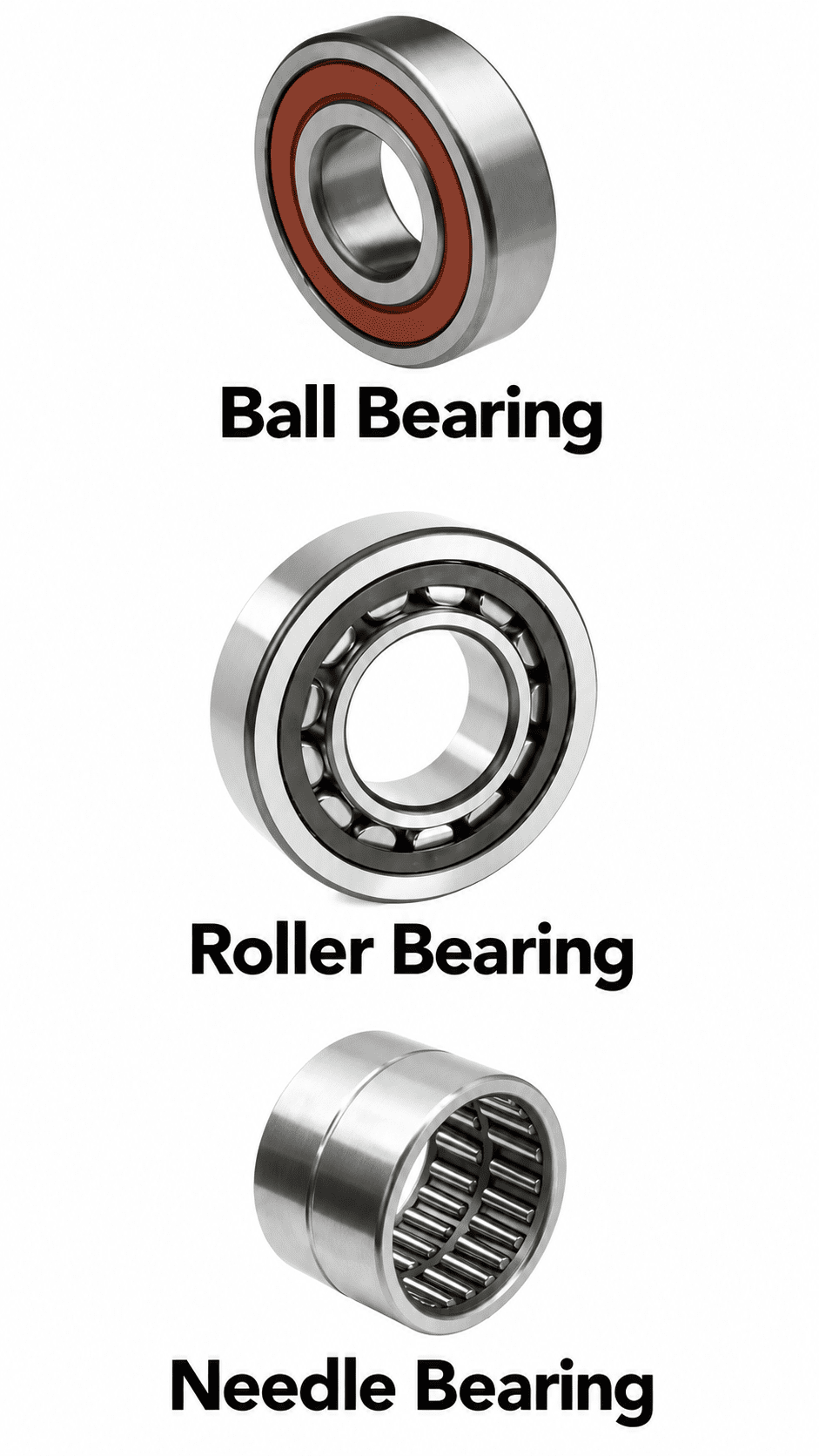
Ball bearings, among the most commonly used, work by reducing contact between rotating and moving surfaces using balls housed between two raceways. This type is particularly effective for moderate radial loads and can also support moderate axial (thrust) loads. Their design allows for high rotational speeds with low friction, making them ideal for applications like electric motors, where heat and wear are minimized.
Main applications: Electric motors, household appliances, office equipment, precision machinery.
Roller Bearings
Roller bearings are designed for heavy radial loads and high robustness, particularly in demanding industrial environments. They come in several types:
- Cylindrical roller bearings: Optimized for heavy radial loads. Their design prevents axial displacement, except in specific versions designed for that purpose.
- Tapered roller bearings: Adapted for combined radial and axial loads, thanks to an angled arrangement that allows them to withstand significant forces. They are often used in the automotive industry, particularly for wheel bearings.
- Spherical roller bearings: Tolerate misalignment and absorb heavy loads, making them ideal for conditions involving shaft deflection or misalignment. Used in construction equipment and heavy industry, they combine robustness and flexibility.
Main applications: Industrial machinery, transmission systems, construction and site equipment, wheel bearings.
Needle Roller Bearings
Needle roller bearings contain thin, long rollers, allowing for extensive contact with the raceways and better distribution of radial loads in tight spaces. Their compact size and ability to support heavy radial loads make them the components of choice in gearboxes and automotive steering systems.
Main applications: Gearboxes, automotive steering systems, transmission systems, compact machinery.
Understanding Bearing Loads
Depending on its configuration and type, a bearing can support several types of loads, which directly impacts its durability and application:
- Radial loads: These loads are applied perpendicularly to the bearing's axis of rotation. Roller and ball bearings are particularly well-suited for this type of load.
- Axial (thrust) loads: These loads run parallel to the axis of rotation. Ball bearings and tapered roller bearings can support light to moderate axial loads, while certain special roller bearing designs offer increased resistance.
- Combined loads: This is a combination of radial and axial loads. Tapered roller bearings and certain spherical bearings are designed to effectively handle this type of mixed load.
Criteria for Choosing a Bearing
To select the right bearing, several technical criteria must be considered, including:
- Type of application: Each bearing type is suited to specific speed, friction, and load conditions. For example, ball bearings are suitable for high speeds, while spherical roller bearings are preferred for heavy loads and misalignment conditions.
- Load capacity: Choosing a bearing with a load capacity suited to the applied forces ensures an optimal lifespan.
- Mounting conditions and dimensions: The available size and space influence bearing selection, as does the mounting method, which can vary depending on the type and accessibility within the equipment.
Most Commonly Used Bearings
Among all bearing types, ball bearings are the most commonly used due to their versatility and ability to operate effectively in many applications. However, for heavier loads or specific conditions, roller bearings and housed bearing units (pillow blocks/flanges) may be better suited.
Conclusion
Choosing the right type of bearing is essential to optimize the performance and longevity of your machinery. Each type of bearing offers specific features, whether it's ball bearings for their versatility and high-speed capabilities, or roller bearings for their robustness under heavy loads. By considering the application conditions, the loads to be supported, and space constraints, you can select the bearing best suited to your needs. At 123bearing, we offer a wide range of bearings to meet all your industrial and mechanical requirements. Feel free to consult our team for expert advice to ensure your equipment runs smoothly.
 DEEP GROOVE BALL BEARING
 NEEDLE ROLLER BEARING
 ROLLER BEARING
 HOUSED BEARING
 ROD END
 OTHER BEARINGS
 GEARBOX BEARING
 AGRICULTURAL BEARINGS
 WHEEL BEARING
 SINGLE ROW
 DOUBLE ROW
 CERAMIC BEARING
 THRUST BALL BEARING
 SELF ALIGNING BALL BEARING
 CASTOR BEARING
 HIGH TEMPERATURE
 CAM FOLLOWER
 TRACK ROLLER
 MAST GUIDE BEARING
 BALL BEARING RETAINER
 DRAWN CUP ROLLER BEARING
 NEEDLE ROLLER BEARING
 AXIAL NEEDLE ROLLER
 INNER RING
 NEEDLE ROLLER CAGE
 DRAWN CUP ROLLER CLUTCHES
 TAPERED ROLLER BEARING
 ROLLER BEARING
 YOKE TYPE TRACK ROLLER
 SPHERICAL ROLLER BEARING
 THRUST ROLLER BEARING
 ROLLER BEARING CAGE
 RAW CONE
 RAW CUP
 HOUSED BEARING 0 BOLT
 HOUSED BEARING 1 BOLT
 HOUSED BEARING 2 BOLTS
 HOUSED BEARING 3 BOLTS
 HOUSED BEARING 4 BOLTS
 HOUSED BEARING ACCESSORIES
 TSM ROD END
 TSF ROD END
 GE ROD END
 DIN ROD END
 GEG ROD END
 SQ ROD END
 SA ROD END
 SSR ROD END
 SI ROD END
 GEEW ROD END
 SQZ ROD END
 TPN ROD END
 TAC ROD END
 SQL ROD END
 GEK ROD END
 PHS ROD END
 GEZ ROD END
 GEEM ROD END
 TAPR ROD END
 GAC ROD END
 GX ROD END
 OTHER ROD ENDS
 SEAL
 SEALING ACCESSORIES
 O-RING SEAL
 ROTARY SHAFT SEAL
 HYDRAULIC SEAL
 V-RING SEAL
 X-RING SEAL
 SEALING WASHER
 WIPER SEAL
 ROPE SEAL
 VK EC END COVER
 NILOS SEALS
 OTHER SEALS
 PISTON SEAL
 PNEUMATIC SEAL
 SEAL ASSORTMENT
 AUTOMOTIVE SEAL
 PTFE SEAL
 BACK-UP RING
 SPEEDI-SLEEVE
 BELT
 ROLLER CHAIN
 SPROCKET
 TAPER BUSHING
 V-GROOVED PULLEY
 TIMING BELT PULLEY
 RACK & SPUR GEAR
 RIBBED BELT PULLEY
 LINEAR
 AUTOMOTIVE
 COUPLING
 V-BELT
 RAW EDGE COGGED V-BELT
 TOOTHED BELT
 POLY-V BELT
 HEXAGONAL BELT
 VARIATOR BELT
 BELT ACCESSORIES
 SIMPLEX
 DUPLEX
 TRIPLEX
 CONNECTING LINK
 OFFSET LINK
 CHAIN ACCESSORIES
 SIMPLEX SPROCKET
 DUPLEX SPROCKET
 TRIPLEX SPROCKET
 IDLER SPROCKET
 V-GROOVED PULLEY SPA
 V-GROOVED PULLEY SPB
 V-GROOVED PULLEY SPC
 V-GROOVED PULLEY SPZ
 TIMING BELT PULLEY T2.5 2,5MM
 TIMING BELT PULLEY T5 5MM
 TIMING BELT PULLEY T10 10MM
 TIMING BELT PULLEY AT5 5MM
 TIMING BELT PULLEY AT10 10MM
 TIMING BELT PULLEY 3M 3MM
 TIMING BELT PULLEY 5M 5MM
 TIMING BELT PULLEY 8M 8MM
 TIMING BELT PULLEY 14M 14MM
 TIMING BELT PULLEY L 9,52MM
 TIMING BELT PULLEY XL 5,08MM
 TIMING BELT PULLEY H 12,7MM
 SPUR GEAR
 GEAR RACK
 RIBBED BELT PULLEY PL
 RIBBED BELT PULLEY PJ
 LINEAR BALL BEARING
 ROLLERS GUIDE CARRIAGE
 NEEDLE ROLLERS FLAT CAGE
 LINEAR BEARING HOUSING
 SHAFT GUIDE RAIL
 BALL SCREW
 WATER PUMP
 TIMING BELT PULLEY
 TIMING BELT KIT
 ACCESSORY KIT
 ALTERNATOR PULLEY
 HALF-COUPLING
 FLECTOR
 RUBBER INSERT
 LUBRICANT
 ADHESIVE
 PENETRANT
 LUBRICANT
 GREASE
 DEGREASER
 CLEANER
 THREADLOCKER
 GLUE
 ADHESIVE
 GASKET SEALER
 GASKET SEALING
 CYLINDRICAL BUSHES
 RETAINING RING
 BALLS AND NEEDLES
 WASHER
 TOOLS
 ANTI VIBRATION
 LOCK NUT
 ADAPTER SLEEVE
 PAP BUSHES
 FLANGED BUSH PAF
 BRONZE BUSHES WITH COLLAR
 BRONZE BUSHES
 EXTERNAL RETAINING RING
 INTERNAL RETAINING RING
 E-CLIP
 CIRCLIP PLIERS
 NEEDLE
 BALLS
 BALL BEARING RETAINER
 THRUST WASHER
 LOCK WASHER
 WAVE SPRING WASHER
 COMPRESSION WAVE SPRING WASHER
 MULTIWAVE COMPRESSION SPRINGS
 OVERLAP WAVE SPRING WASHER
 CURVED SPRING WASHER
 SPRING DISC DIN2093
 FINGER SPRING WASHER
 SPLIT WAVE SPRING WASHER
 WAVE SPRING ROUND WIRE
 CIRCLIP PLIERS
 DIMENSIONAL MEASUREMENT
 MOUNTING - DISMOUNTING
 GREASE - LUBRICATION
 ALIGNMENT - INSPECTION
 MM ANTI-VIBRATION
 MF ANTI-VIBRATION
 PM ANTI-VIBRATION
 FF ANTI-VIBRATION
 PF ANTI-VIBRATION
 ANTI-VIBRATION MACHINE BASE
 PMP ANTI-VIBRATION
 ANTI VIBRATION DIABOLOS
 PFP ANTI-VIBRATION
